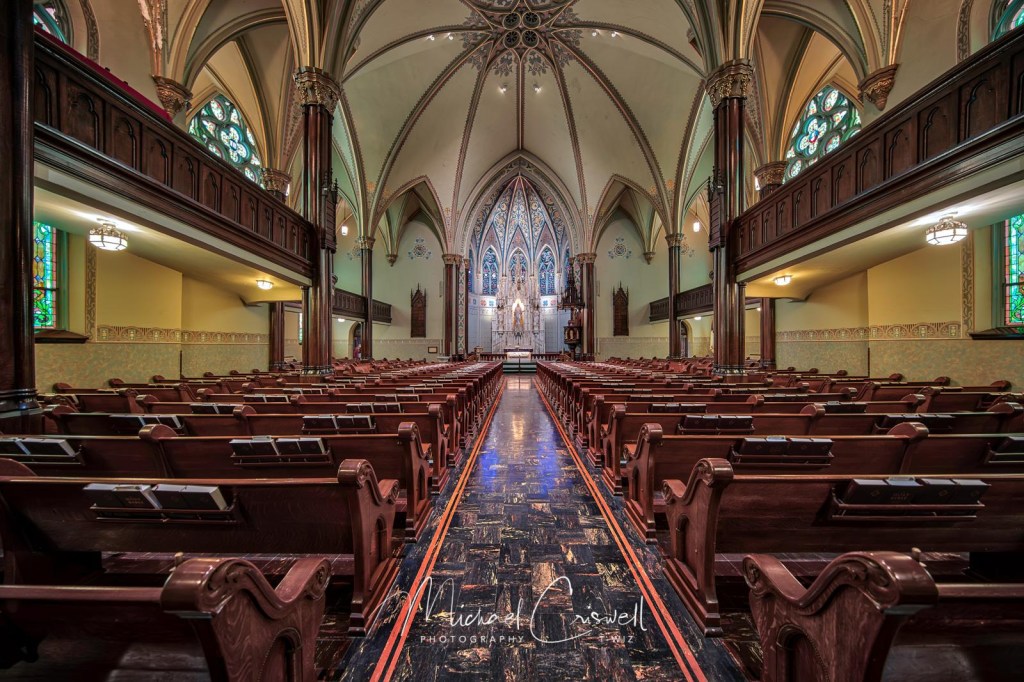
The Summit City. The City of Churches. Home of Concordia Theological Seminary and former home of Concordia Senior College, Concordia College, and what is today Concordia University Chicago. Former haunt of LCMS organizers Friedrich Wyneken and Wilhelm Sihler. Able to boast of 31 LCMS churches, ten LCMS elementary schools, one of the nation’s largest LCMS high schools, an LCMS newspaper, a Lutheran social services agency, a Lutheran Foundation, a TV ministry, the synod’s oldest ladies’ aid, and the list goes on.
Relevant to the purposes of this blog, Fort Wayne can also boast of one of the proudest Walther League histories of any city in the United States.
Fort Wayne’s first Lutheran Jünglings-Verein and Jungfrauen-Verein (young men’s and young women’s societies) were organized by 1852, making them among the oldest in the LCMS. As St. Paul’s birthed multiple daughter congregations (in 1867, 1883, 1893, and 1899), a “German Lutheran Young People’s Society of Fort Wayne” was organized to help foster fellowship between young Lutherans across the city.
When the young men’s society of Trinity, Buffalo, issued invitations to help create a national Lutheran young persons’ league, St. Paul’s and Emmanuel’s young men’s societies jumped at the opportunity, becoming two of the fourteen charter societies of the Walther League. The following year, Fort Wayne played host to the second Walther League convention, the same convention where the league adopted its long-beloved name. Fort Wayne went on to host six more national conventions between 1898 and 1929, tying Milwaukee as host to the greatest number of Walther League conventions. The city also played host to many conventions of the league’s Indiana District.

1929 Walther League convention souvenir stamp
Fort Wayne was also the home of numerous leaders in the Walther League, including many members of the executive board (3/4 of the board were Fort Wayne residents throughout much of the 1920s) and three Walther League presidents (F. A. Klein, 1904–1909; Ernest Gallmeyer, 1928–1933; and Walter E. Helmke, 1933–1938). F. A. (“Pap”) Klein, whose day job was teaching at St. Paul’s school, additionally gained national popularity in his role as field secretary (1910–1919). During those ten years, Klein spent nearly every weekend on the road, “boosting” for the league in cities across the United States. Klein’s efforts paid off handsomely, resulting in growth from 3,800 members in 1910 to 23,000 members in 1919.
Meanwhile, Walther League membership in Fort Wayne grew rapidly too. In 1910, all of the leagues in and around the city joined hands to create a unified Fort Wayne city league, sponsoring regular plays, banquets, concerts, athletic tournaments, parties, etc. By 1915, the city boasted that it was “the brightest spot on the Walther League map.” By 1921, Fort Wayne had over 1,500 members; by 1924, that number had increased to 2,000. Two years later, the Walther League societies in Fort Wayne and Allen County collaborated in publishing their own monthly newspaper, the Walther Leaguer.

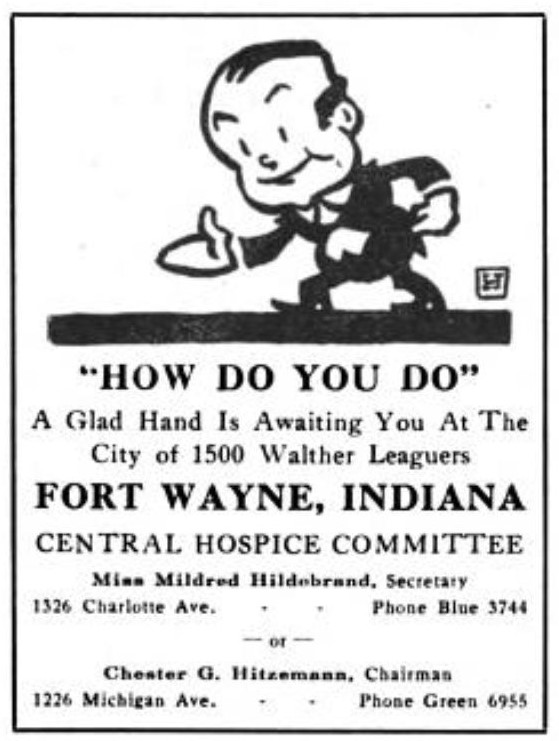


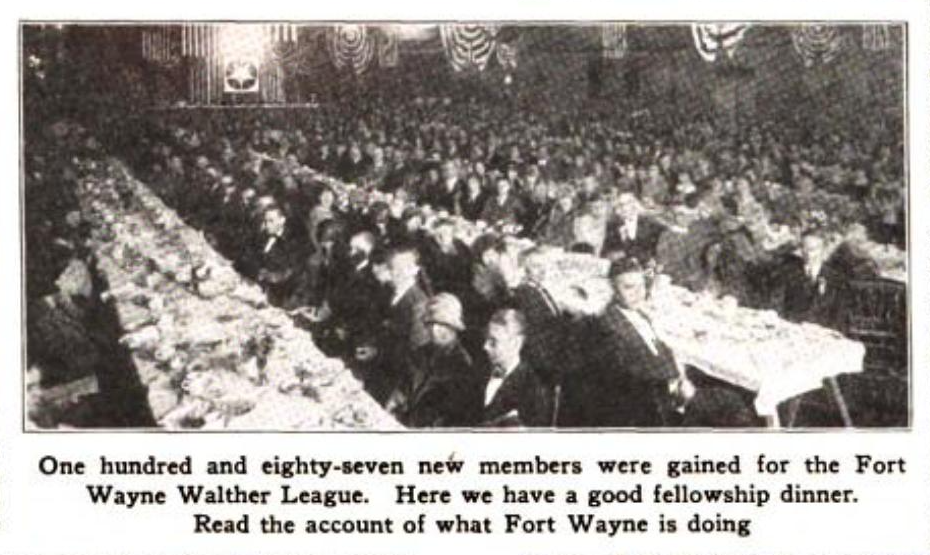
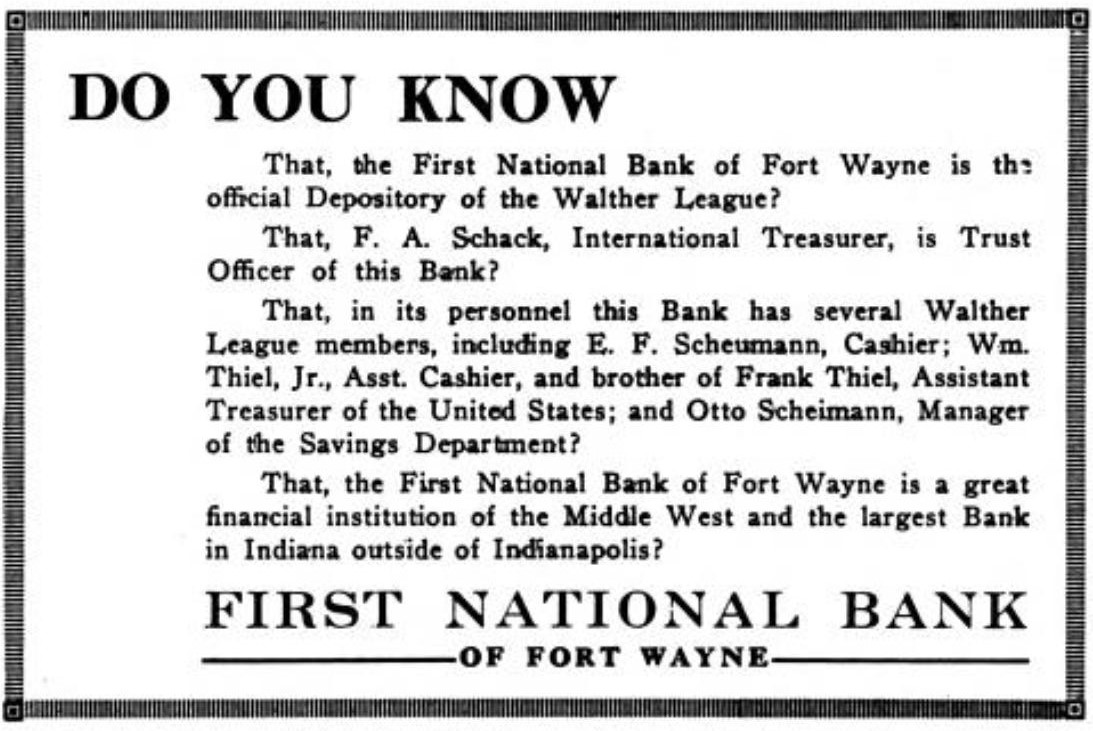
In 1917, the Fort Wayne league helped to organize the Fort Wayne Lutheran Choral Society, which held regular concerts both in Fort Wayne and occasionally across the country. The Fort Wayne Lutheran Basketball Association and Fort Wayne Lutheran Dartball League were both organized around this time, as were separate leagues for softball and bowling. Fort Wayne also had an active hospice committee and had been raising funds to purchase a house for young Lutheran men and/or women to stay in when the Great Depression put an end to those plans.
In 1922, the Fort Wayne Walther League collaborated with the American Luther League (headquartered in Fort Wayne) and St. James Lutheran Church in Lafayette, IN, to sponsor the creation of the “Purdue University Concordia Club,” which was the forerunner of today’s Beta chapter of Beta Sigma Psi.

Original structure of the “Purdue University Concordia Club,” a home for young LCMS men studying at Purdue University.
Though certainly a significant project, this was not Fort Wayne’s first venture in charitable activity outside of its own borders.
The Walther League’s most famous project—the Wheat Ridge Sanitarium—got its start thanks to the efforts of a Fort Wayne leaguer. Dr. Heinrich G. Merz was a practicing physician in Fort Wayne when he contracted tuberculosis. He moved temporarily to Denver for his health, where he witnessed the plight of many of his fellow Lutherans who were also suffering from the disease. To help ease the overcrowded conditions and provide financial assistance for poor Lutherans who could not afford treatment, he spearheaded the creation of a Lutheran Sanatorium Society in October 1903. He appealed to the Walther League for assistance the following month, and in January 1904, he received his first financial contributions—which came from his home town.
The Fort Wayne Walther League also assisted the American Luther League in its efforts to defend parochial schools from outside threats in the early 1920s and enthusiastically supported KFUO and The Lutheran Hour when they first came on the scene in the 1920s–1930s. When the Lutheran orphanage in Indianapolis found itself in need of funds, Fort Wayne, together with the other societies in the state, immediately set about raising funds. The same was true when several missionaries requested funds to support their activities overseas.
One reason the Fort Wayne league was so large and successful during this time is that it had some truly impressive local leadership. Unlike most Walther League societies, the Fort Wayne societies allowed married couples to remain as active members starting fairly early on. Many older members also remained in the league as honorary leaders and mentors, providing the league with stable, continuous leadership over a span of decades.
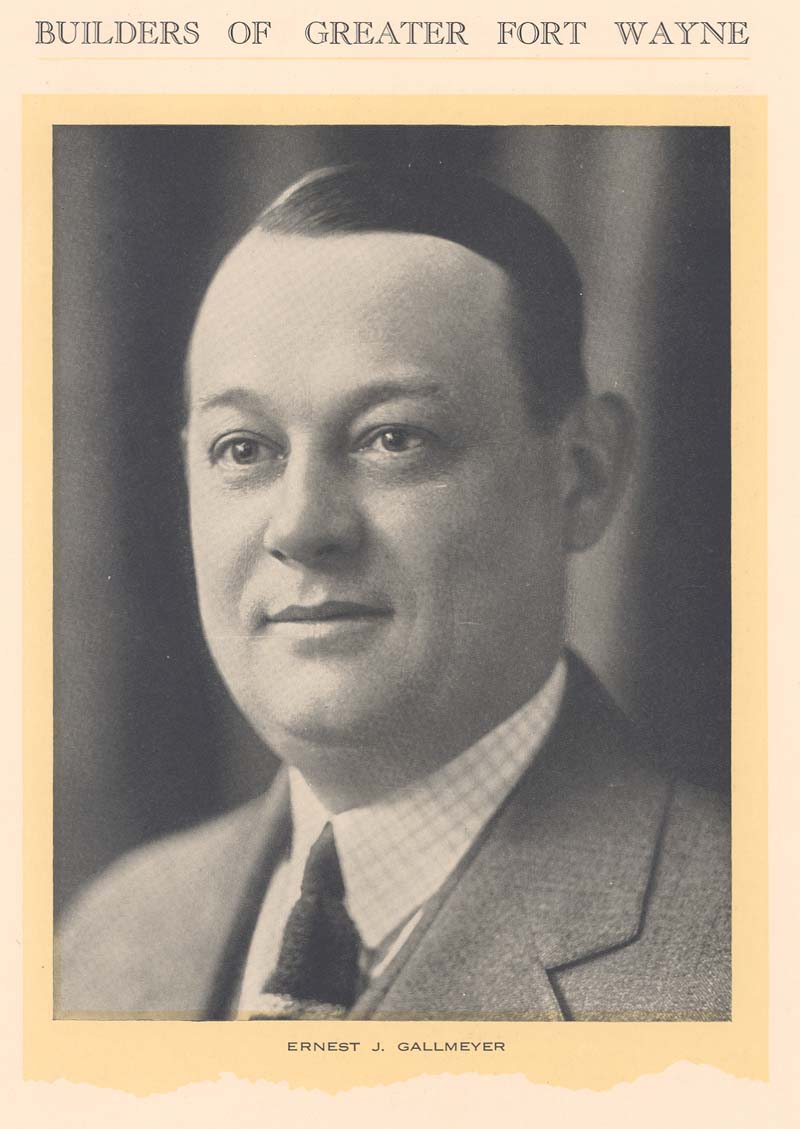



For example, Ernie Gallmeyer, mentioned earlier, was an active leader in St. Paul’s Walther League society, served as president of the International Walther League, and served as president and chairman of the Arcadia Summer Conference Association. He also helped raise funds to buy Valparaiso University, served as president of the International Lutheran Layman’s League, and held numerous positions of service and authority in other charitable and civic ventures in Fort Wayne, all in addition to working as the treasurer of a local realty firm.
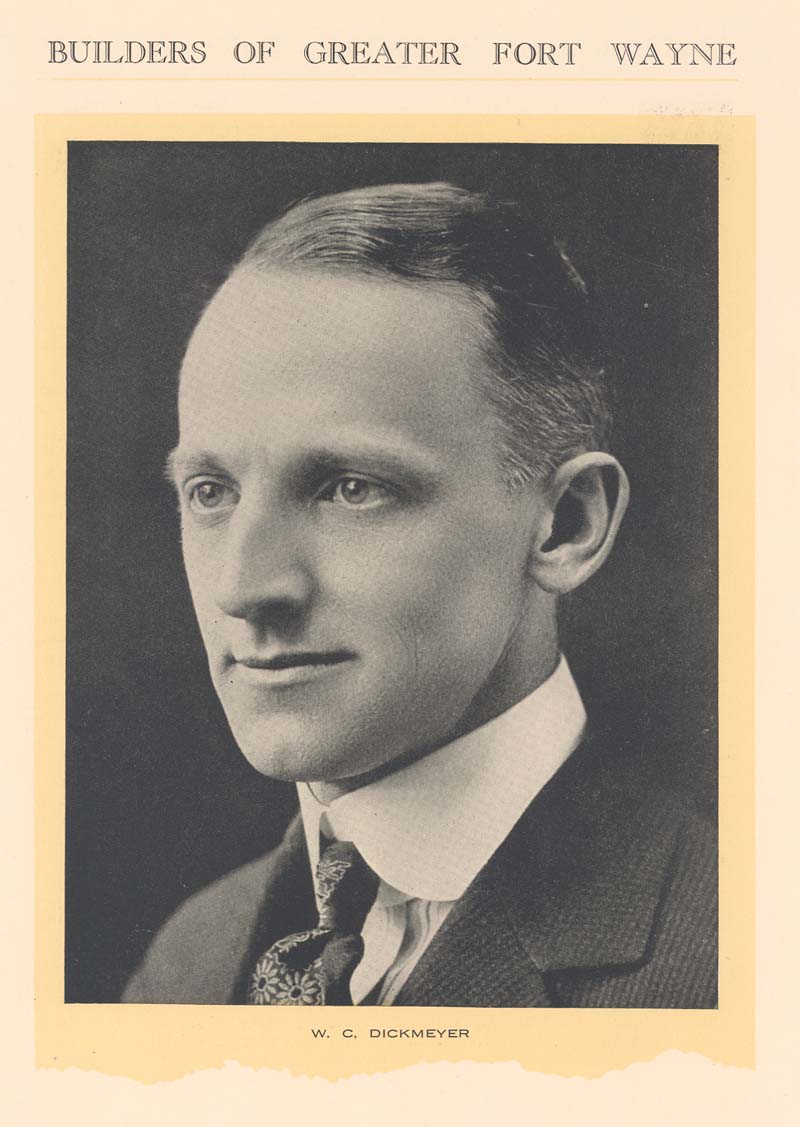
August Becker was, at 72, a retired, well-to-do businessman, serving on the advisory board of the Lutheran Hospital, the board of directors of the Lutheran Deaconess Association, and the board of trustees of the Lutheran Children’s Friends Society (today Lutheran Social Services). He was also an active Walther Leaguer. August Borgmann, 59, was another active member. Charlie Dickmeyer, 43, was another. Both were prominent businessmen. Dr. Edward Kruse, 43, a physician at the Lutheran and Methodist hospitals, was still another.
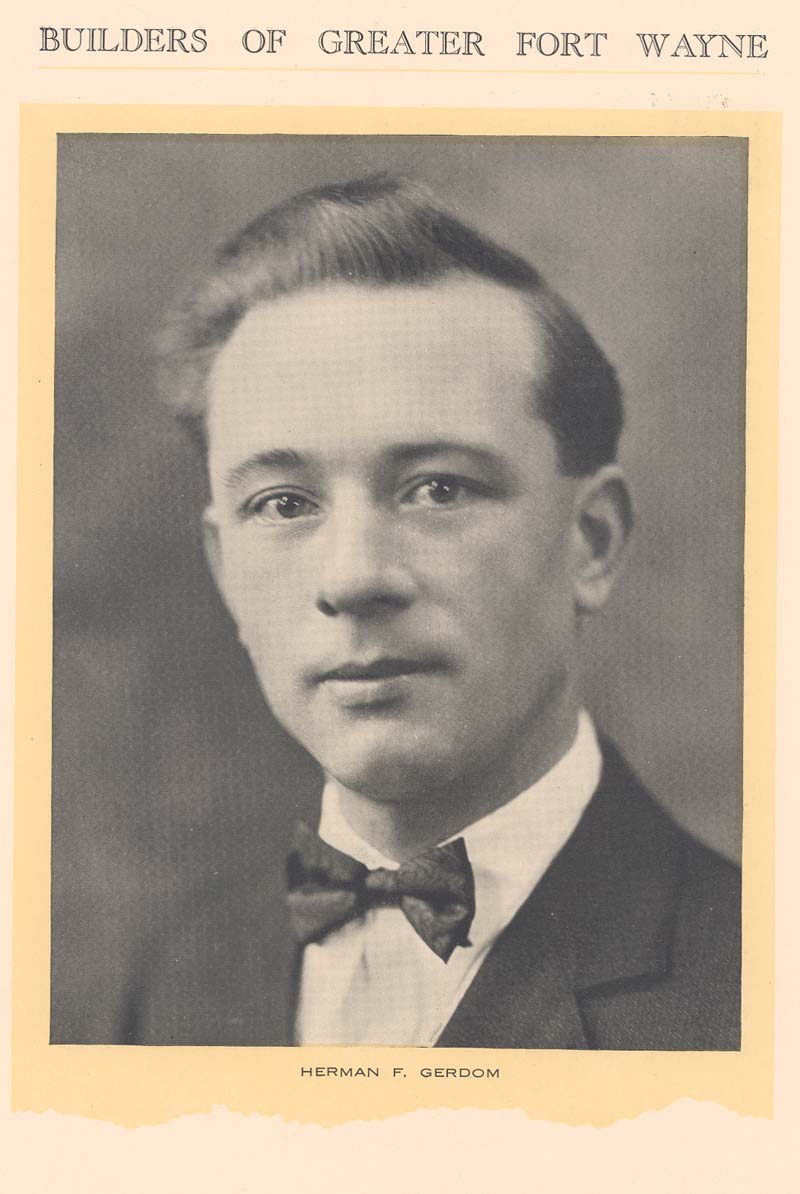
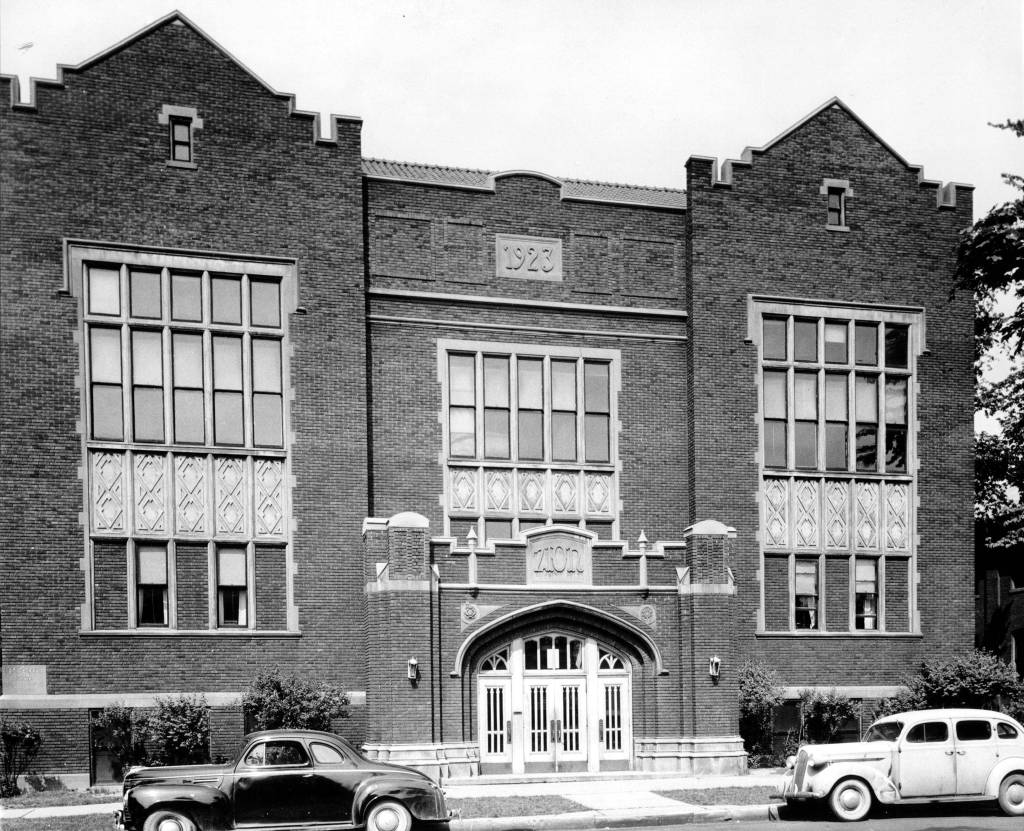
Another businessman, Herman Gerdom, deserves special mention. Gerdom was elected as secretary of Zion’s Walther League shortly after joining the society as a young man. Under his leadership, the membership climbed to over 300, a monthly newspaper was started (the Zion’s Booster), and, after 13 years of planning, a massive three-story parish hall, complete with auditorium/gymnasium, cafeteria, and meeting rooms, was donated by Zion’s Walther League to the church at a cost of $125,000 ($2.2 million in today’s currency). This was no doubt one of the most impressive accomplishments in the Fort Wayne Walther League’s history.

ADDENDUM, 1/21/2023: I can’t believe I forgot to mention this, but Fort Wayne was also the home of architect J. M. E. Riedel, who designed the ten-sided star logo that the Walther League adopted in 1896.
✠
Having looked a bit at Fort Wayne’s proud Walther League history, what about today? With its large Lutheran population, many congregations and schools, and one of the synod’s two seminaries (to say nothing of its sizeable Lutheran Foundation), I believe that Fort Wayne is ideally suited to become the breeding ground of a renewed Walther League.
Fort Wayne has the Lutheran population density to once again support a Lutheran choral society, Lutheran athletic leagues, and, as time goes on, possibly even a new Lutheran youth building. It has prominent lay members who could offer advice in creating a new league. It has a large (though shrinking) number of older members who remember their Walther League involvement fondly and who may be willing to support its resurrection.
In addition, Fort Wayne is relatively close to a number of active LCMS campus ministries—at Purdue, Ball State, Indianapolis, Terre Haute, Valparaiso, and so on. It is fairly centrally-located for many entertainment, cultural, and natural attractions in the East North Central States, including the ever-popular Cedar Point amusement park. It is the headquarters of the LCMS’ Indiana District, with the benefits that entails.
It is also, incidentally, my hometown. So if you’d like, you can consider this whole post a bit of advertising for what once was, and what I believe could be again. If you’re from the Fort Wayne area and like the idea of bringing the Walther League back, let me know. Same goes if you know of someone else who might be so interested.
✠
Concordia Theological Seminary will hold its annual symposia series this week, bringing many pastors to the Fort. If any readers will be in town and would like to talk about resurrecting the Walther League, I would be happy to arrange my schedule to meet any night but Monday. Just let me know by responding here or, if you have the relevant information, contacting me via text, email, or Facebook.
 Walther League Redux
3 responses to “Fort Wayne”
Where are you at with things now on a new Walther League? Any new developments? Thanks!
LikeLike
Wondering the same thing…very interested in hearing about progress as our Youth program at church could certainly use some help!
LikeLike
let’s go! The fact that we hold annual youth events (district and national) at secular venues is odd….let’s resurrect the league and bring young people to the campus at Ft Wayne or perhaps LCC in Wyoming.
LikeLike